Monday, December 13, 2021

When your study organism fights back...

I explained back in this previous post about how important decomposition is for an ecosystem. Without the recycling of dead plants through decomposition, new plants wouldn't have enough nutrients to grow! It's such an important process that scientists have been studying it for decades. We want to understand what determines the speed of decomposition, and the way that the nutrients are recycled.

Of course, decomposition in the desert can be very different from other ecosystems, because it is very dry and hot, so biological processes (like decomposition) can be much slower. Another reason that desert decomposition can be different is that we have a lot of unique plants that become that "plant litter" that decomposes. Our plants are well-defended against herbivores, which means they are also (often accidentally) well-defended against decomposers! Decomposition studies don't often look at those unique plants. For example, there are only very few studies that have measured cactus decomposition. Even though cacti are an incredibly abundant plant in the Sonoran Desert, we don't know much about their life-after-death role in the ecosystem!

Students in my lab got curious about cactus decomposition, so we set up an experiment. 

Miranda and Ephraim building cactus decomposition cages.

The normal way to study decomposition is using litterbags, like I showed you here. But that's hard to do with a whole piece of cactus, because of the spines that stick out! It's hard to bag a plant that fights back! Ouch! So we built "cages" on the ground made out of the same material that is used for litterbags. These cages trap the cactus in place, so that we can refind each piece to measure its decomposition.

We put two different species of cactus into the cages. Both species are common in the Sonoran Desert. Prickly pear cacti have big, flat segments (called "clades") with large spines but are very juicy inside. Cholla clades are hard and cylindrical, and while they still have soft insides, they have a thicker skin on the outside that might make it hard for decomposers to eat through. So we hypothesized that these two species would decompose at different rates, and release different amounts of nutrients.
The big, flag cactus in the cages on the left are prickly pear, and the skinny, round cactus in the right-side cages are cholla.

Once our fresh cacti were in their cages, we let them decompose for a year. They went from looking like this at the beginning of the experiment...
The holes in these prickly pear clades are from cores that we used to measure their chemical properties at the start of the experiment.

...to this one year later!

Over the course of the year, we collected some of the cacti every few months so that we could track how much mass and nutrients had been released during decomposition. So, every few months, we brought the cacti back into the lab to measure their weight and chemistry:
Guillermo, Coby, and Chase breaking apart a decomposing cholla clade to measure its chemistry.

What did we learn about cactus decomposition? We learned that decomposing cacti recycle nutrients just as well as leaves from deciduous shrubs and trees. We also noticed that cacti recycle a LOT of calcium, way more than other types of plants (almost 10 times as much as other leafy plants!). That's because cacti have a lot of compounds called "calcium oxalates", which means there's a lot of calcium stored in their clades to be recycled when they die. 

We also learned that, despite the differences between prickly pear and cholla, their decomposition is pretty much the same... at least over the first year that we investigated in this study. There are a few differences between the species, though. Prickly pear released more water than cholla, and it also released potassium (an important nutrient for new plants!) faster.

There is still a LOT left to learn about cactus decomposition. We only looked at two species in one desert site, which is just a "drop in the bucket" for understanding how important cacti are in desert ecosystems. But what we do know is that cacti have an important role in nutrient recycling, so it is worth learning more about it!

The results of this study are published in: Bilderback, A.H., A.J. Torres, M. Vega, B. Ball. 2021. The structural and nutrient chemistry during early-stage decomposition and desiccation of in the Sonoran Desert. Journal of Arid Environments. 195: 104636. DOI:10.1016/j.jaridenv.2021.104636

Tuesday, April 27, 2021

Sonoran Desert BioArt

Last year I told you about our course in BioArt. Students work in teams to conduct research in the Sonoran Desert, and they communicate that research through a creative work of art. In the Spring semester of 2021, we had another great group of students work on projects in this course, creating wonderful works of Sonoran Desert art!

Anastasia and Rachael studied the role of desert vertebrates in the spread of cholla, a common cactus species in the Sonoran Desert. Cholla spreads to new habitats by dropping segments of the plant (called "tubercles") that can take root in the soil where they land. These tubercles are covered in hooked spines that work like velcro: they catch on the fur of coyotes, rabbits, and other mammals to be carried around and dropped somewhere new, away from the parent plant. So these animals are important to help spread this cactus, but humans are changing the abundance of these animals! How will urbanization impact the spread of this desert plant species? Anastasia and Rachael used camera traps and other survey techniques to learn which animals were associated with cholla plants. They learned that coyotes, deer, rabbits, and packrats were active in the area around chollas in the Sonoran Desert. Learn more about it in their research poster.

To demonstrate the action of a tubercle being removed from the cactus and spread to new habitats, Anastasia and Rachael created a soundscape video and an interactive cactus model. You can play the video to hear the sound of a tubercle being ripped from the cactus as it would be by a passing desert mammal. Tubercles stick to mammalian pelts because of tiny barbs on the cactus arms, ripping the tubercle off the main body like Velcro is ripped apart. This is the reasoning behind creating the interactive cactus model – arms are attached to the cactus body via Velcro, so viewers can experience the sensation of ripping a cactus arm off the main body. 

Joe and Mikayla explored whether the number of arms on saguaro cacti are related to water availability. Scientists don't actually know what signals saguaros to grow their iconic arms. We know it doesn't happen until they are older, and some saguaros don't grow arms at all! One hypothesis is that the arms are for extra water storage, in which case the number of arms would relate to water availability. Mikayla and Joe measured soil moisture along gradients from sources of water, and counted the number of arms on the saguaros at those locations. They did not find a relationship between soil water (or distance from the source of water) on the number of arms on the saguaros growing there. So... the reason for saguaros to grow arms remains a mystery! Learn more about it in their research poster.

To communicate their research, they created a glass tile mosaic that highlights the impact water availability has on Saguaro cactus branching. The recycled glasses contain blue marbles, representing the availability of water to each mosaic Saguaro it sits below. Both glasses contain the same amount of marbles, due to the research determining no significant difference between the water available to a Saguaro and its number of branches. This beautiful mosaic also sheds light on the complexity of Saguaro growth and the need for more research in this area. 

Jared and Irvin designed a rain garden that can maximize plant productivity with efficient water use in the Sonoran Desert. Rain gardens are a common form of "urban agriculture" that rely on rainwater to survive, but is that actually feasible in a desert city that doesn't receive a lot of rain? They used an infrared gas analyzer to measure the water use efficiency of native desert plants, and used their results to select the best plants to include in their design for a Sonoran Desert rain garden. Learn more about it in their research poster.

Irvin and Jared then designed the landscape for the garden using these efficient native plants, focusing on those that have tangible benefits to the community (like being a source of food or fiber for people). Of course one semester is not enough time to actually construct an entire garden, but in their blueprint, they designed it to contain artistic elements that would make it beautiful for visitors. The garden consists of three terraces: the ground level, level two at 2’ down, and level three at 3’ down. The blueprint features natural colors from the biotic elements with highlights of the pink milkweed flower and purple fruit from prickly pear. The abiotic elements are made to match the Sonoran Desert aesthetic. 

Monday, October 5, 2020

Nitrogen pollution in the urban Sonoran Desert

 Phoenix is one of the fastest growing cities in the United States. That means a LOT of people live in the city, which means a lot of fossil fuels are consumed. When we think about the environmental impacts of fossil fuels, we usually hear about carbon dioxide (which is a greenhouse gas and contributes to global warming and climate change). But that's not the only down-side to fossil fuels. Another form of pollution caused by burning fossil fuels is "nitrogen deposition". 

When fossil fuels are combusted in, for example, a car engine, nitrogen compounds are released into the air. While these compounds are in the air, they go through chemical reactions and eventually fall back to the ground. This is one of the components of "acid rain", which you've probably heard of before. But here in the Sonoran Desert, it's a bit different. We don't have a lot of rain. So sometimes the nitrogen comes down in the rain, but sometimes it comes down in dry particles, kind of like dust. That's why we call it "nitrogen deposition". Deposition just means everything coming back down to the ground - it can be either wet (like rain or snow) or dry (like dust).

We know that the Sonoran Desert is receiving extra nitrogen deposition around Phoenix. How do we know? We measure it! Our research group (CAP-LTER) has many research sites inside and outside of Phoenix where we measure how much nitrogen is coming down to the ground. We use what we call "deposition collectors", which are a group of funnels that catch the dust and rain. Filters connected to the bottom of the funnels collect all of the nitrogen compounds that came as part of the dust and rain. The filters get collected on a regular basis for measurement.

You can watch this video where our Site Manager, Quincy, shows you the "deposition collectors" and how he gathers the filters for measurement:


From these "deposition collectors", we know that the desert areas inside the Phoenix urban area are receiving more nitrogen than outside the city. The large population of Phoenix is having an impact on how much nitrogen is in the Sonoran Desert! Not only do we measure how much nitrogen is coming down, but we also measure how that nitrogen influences in the Sonoran Desert plants and soil.

Nitrogen is a nutrient that all organisms need, but it becomes a problem when there's too much of it. (You CAN have too much of a good thing!) Nitrogen can become toxic in high concentrations and kill the organisms living in the soil. It can even make humans sick if it gets into the groundwater! Plus, adding a lot of nitrogen can upset the balance for the ecosystem. (For example, you can read here how excess nitrogen causes problems at some national parks.)

Our research group (the CAP-LTER) has been measuring the impacts of that nitrogen pollution since 2006. The nickname we give that experiment is "DesFert", which is short for "Desert Fertilization Experiment". CAP-LTER has been following the excess nitrogen in the plants and soils to see how the Sonoran Desert changes with these extra nutrients. We also experimentally add extra fertilizer to our research plots to predict how the Sonoran Desert will continue to change if the pollution continues.

If you want to see what the research plots look like, and learn a little bit about the actual measurements we make, you can watch this video:


Tuesday, April 21, 2020

BioArt in the Sonoran Desert

BioArt: Sonoran and Arctic Environments is an interdisciplinary course at Arizona State University’s West Campus that pairs science and art majors to conduct independent scientific research and science communication through art. While the disciplines of science and art are usually considered to be very different, they actually require a similar set of skills: observation, interpretation, creativity, and communication. Students in this course hone these skills by studying both art and science in two ecosystems that are also considered to be very different, yet in fact similar in many ways: the Sonoran Desert and the Arctic. The goal is to train a broader group of students in both disciplines and engage them in science communication.

The product of these scientist-artist teams gets displayed in an exhibition, including the traditional scientific presentation of their research, as well as the creative work that conveys the research through a different medium. The most recent set of projects was exhibited in August & September 2019 at the Fletcher Library at ASU. This spring, the work was set up for display at the South Mountain Environmental Education Center, to be enjoyed by visitors to South Mountain Park. That way, visitors to this Sonoran Desert reserve could see science and art based on that ecosystem! Unfortunately, that display was cut very short. It was up for only one weekend before the visitor center was closed due to the COVID-19 pandemic! Since it can no longer be enjoyed by in person, I thought I could perhaps publish it here, for people to enjoy remotely all over the world.

So, without further ado, I present to you the BioArt projects from the Sonoran Desert!

Lourdes, Mohammad, and Rebecca explored how different amounts of precipitation can influence the abundance and diversity of wildflowers in the Sonoran Desert. They learned that different locations have different wildflower communities, though humans may have a role in creating those communities, not just precipitation alone. Learn more about it in their research poster.
This trio of canvases represents how rainfall can influence heterogeneity of wildflower communities around Phoenix. The blue paint at the bottom of the canvas represents how many centimeters of rain fell from December 31st, 2018 through March 1st, 2019 at three different locations in the Phoenix area. Our goal is to show which species of wildflowers were most common at each site that was surveyed. The most common species of wildflowers were centered around the least common wildflower species.

Paul & Shauny's experiment investigated the amount of excess nutrients can be found in lakes next to recreation areas that use different amounts of fertilizers, and whether that makes algal blooms likely in those areas. They found more algae in lakes near fertilized areas, with the amount of nutrients depending upon the management practices used.  Read more in their research poster.
Essential nutrients include nitrogen (N), phosphorus (P), and potassium (K) to nourish and sustain life in both terrestrial and aquatic environments when present in properly balanced quantities. An imbalance in nutrient levels, such as that caused by the addition of fertilizer to a terrestrial ecosystem which runs off into a nearby waterway, can cause a rapid spike in primary production, depleting resources and ultimately leading to the death of organisms within the system. In their artwork, an unsuspecting abundance of ciliates, flagellates, and multiple algae species swim on shimmering silver stream currents as they feast on an unexpected influx of NPK, the result of fertilizer run-off from a nearby field. Just like phytoplankton, this painting requires light to be vibrant. (Unfortunately, I took this photo at night, so you can't see the light reflection that makes it shimmer!)

Brittany and Kamber investigated how soil fertility changes as you increase in elevation up mountains in Phoenix's park reserves. They found that some nutrients increase with elevation, while others decrease. Read more in their research poster.
Their short film is a visual and auditory representation of the Sonoran Desert and some of the many species of organisms that inhabit it. All photography and videography is original work inspired by our driving question of: “Does human interaction in the Sonoran Desert affect overall soil fertility?” Although experimentation heavily relied on test tubes and various lab work, immersing ourselves in the environment of interest and sharing these experiences through photographs and video has helped support our findings. Yes, human interaction in the Sonoran Desert affects overall soil fertility. We are striving to help others understand that even something as basic as “dirt” is actually nutritionally complex soil in need of our protection. Through both art and science, we can make the world a better place. You can watch their video here:

(Like BioArt and want to see a few examples from the Arctic, as well? See our sister Polar Soils Blog at this post, as well as this post.)

Tuesday, January 21, 2020

Decomposition: the Sonoran Desert's nutritious recycling program

When plants die in nature, they get recycled through the process of decomposition. When a plant dies and falls to the ground, we scientists start to refer to it as "plant litter". Microscopic bacteria and fungi living in soil can eat away at the dead plant litter to return the plant's nutrients to the soil. That's the only way new plants can grow in natural ecosystems! Without the recycled nutrients, new plants couldn't get the nutrition they need to grow.

In a desert ecosystem, though, the bacteria and fungi that decompose plants might have a hard time doing their job. When it is hot and dry, microbes might not be active enough to decompose the plant litter. Then how do plants get recycled in the desert when it's too hot and dry for the microbes?

Another way plant litter can be broken down is by the sun. UV radiation from the sun can break apart the molecules inside the plant. (Anyone who lives here in the Sonoran Desert knows how fast our sun's rays can break down anything we leave out in the yard!) This process is called "photodegradation". Photodegradation of plant litter can happen at the same time as soil microbes are breaking down plant litter, as long as there's sunlight. In a desert, though, sometimes photodegradation can be more important than the biological decomposition by microbes, just given how tough it is for the microbes to survive and how much sunlight we have!

Many scientists have studied the recycling that happens during decomposition by microbes. We know a lot about how nutrients get released into the soil when plant decomposes, especially in places that are cooler and wetter than the Sonoran Desert. We don't know nearly as much about nutrients getting recycled during photodegradation. The biological processes by microbes work differently than the sun to degrade plant litter. We wanted to know if that meant that nutrients are recycled differently when plant litter is being broken down by microbes or the sun.

How did we answer that question? Well, we took plant litter from one species of plant native to the Sonoran Desert. We chose triangle leaf bursage (Ambrosia deltoidea).
Max collecting litter from bursage plants
We put dried bursage leaves into clear pouches that were made out of plastic that either allowed UV radiation to penetrate (and therefore allows photodegradation to happen) or blocked UV radiation (and therefore prevented photodegradation).

Small holes in the plastic allowed soil microbes to invade and biologically decompose the litter when it was able to be active. We put the pouches on the ground to decompose for almost an entire year, and every few months we collected some of the bags to measure the decomposition happening inside the bags.
Bursage litter in their UV pouches in the Sonoran Desert
On all of the pouches we brought back, we measured how fast the plant litter was disappearing. That tells us how fast the litter is decomposing. We also measured how much of the original nutrients are still in the litter. Whatever nutrients are no longer in the litter must have been returned to the soil. The difference between the pouches that allow UV and the pouches that block UV is the result of photodegradation, and tell us about how sunlight changes the way nutrients are recycled compared to the microbes doing it alone.
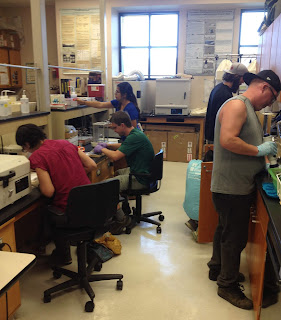
Measuring mass loss and nutrient chemistry on plant litter samples in the lab
The reason we wanted to know about nutrient recycling during photodegradation is because air pollution in Phoenix can add extra nitrogen to the soil. That means we're fertilizing the plants inside the city with extra nutrients, which can change the starting chemistry of the plants. Does that mean city plants recycle nutrients differently from outside plants? We already know that the soil microbes decompose litter faster when there's more nutrients in the litter, because the microbes need their nutrition just like humans! But UV rays shouldn't care about the amount of nutrients in the litter, so will fertilized plants recycle nutrients differently?

To answer that second question, we added another experimental treatment. In the pouches that allowed UV radiation, half of the plant litter was collected from plants that were fertilized while they were growing. We also filled half of the pouches that blocked UV radiation with fertilized litter. The remaining half was filled with natural litter that wasn't fertilized. We also did the experiment in two different places at the same time: Inside the city where air pollution is happening, and outside the city where there's less air pollution.
Bursage litter in their UV pouches in the city of Phoenix.
So what did we learn? Like other studies, we saw that UV radiation sped up the loss of the plant litter from the bags. We also noticed that nitrogen and phosphorus recycling was changed a bit by the UV radiation. UV radiation tended to increase the recycling of nitrogen and phosphorus from the plant litter. That means UV radiation can speed up nutrient recycling when soil microbes aren't being as active as they would be in other cooler, wetter ecosystems. The one exception to this pattern was fertilized litter inside the city... the microbes decomposing the litter in this high-nitrogen setting (of being fertilized AND receiving the city's air pollution) didn't much care for the UV radiation!

We also learned that plant litter grown and decomposed inside the city (where there is more nitrogen pollution in the soil) recycles nitrogen and phosphorus more quickly than litter outside the city.

Why does this matter? It tells us that one of the consequences of the air pollution in Phoenix, which is a rapidly urbanizing area of the Sonoran Desert, is that the way nutrients are recycled during decomposition can change, and that the UV radiation that is so abundant in the desert will play a big part in how it changes. That is important if you are a new plant trying to survive in the Sonoran Desert, because you rely on those recycled nutrients!


The results of this study are published in: Ball, B.A., M. Christman, S.J. Hall. 2019. Nutrient dynamics during photodegradation of plant litter in the Sonoran Desert. Journal of Arid Environments 160: 1-10. DOI:10.1016/j.jaridenv.2018.09.004

Friday, September 28, 2018

Rodents of the Sonoran Desert


The city of Phoenix, AZ is one of the largest and fastest growing cities in the U.S. My lab studies how this urbanization changes soil ecology, but one thing we didn't know much about was how it will change herbivores in the Sonoran Desert. We have a lot of small herbivores who rely on the plants growing in the soil. We know a bit about how plants and soils change... but what about the animals that eat them?

One of my students, Jessica, decided to find out the answer to that question for a particular group of herbivores: small rodents. There are many species of small rodents in the Sonoran Desert that eat either plants or their seeds. These include cute critters like kangaroo rats, pocket mice, and ground squirrels!
For two years, she conducted population surveys of small rodent populations at four sites inside urban Phoenix and four sites outside in the rural, non-urbanized areas. She wanted to find out whether abundances and diversity of small rodents are different when you compare the urban and rural areas. That matters, because small rodents are common vertebrate herbivores who can impact the plants in the desert. Jessica hypothesized that rodents will be more abundant inside the city, because there would be more food for them and fewer predators than out in the rural desert, but that there would be more biodiversity of rodents out in the non-urbanized rural desert, because some species wouldn't have the necessary habitat to survive inside the city.
Jessica used a capture & release method, where she caught mice in humane live-traps, identified their species, and then let them go. In order to do this, we had to have a lot of permits to verify that we were not causing any harm to the rodents. She carefully avoided bad weather and protected them from predators. She became an expert rodent handler and identifier! The surveys were conducted at desert sites inside and outside the city.
We learned from these surveys that abundance is actually the same inside and outside the city. We expected more rodents inside the city, but in fact they are the same inside and out! We did notice, though, that the communities inside the city were very different from outside the city. The rodents inside the city were mostly from just a couple of groups of pocket mice and deer mice, with only a few rodents from other groups present. Outside the city, though, there were pocket mice, kangaroo rats, woodrats, grasshopper mice, and many other types!

We think that this difference is probably related to the food available. The species we found outside the city have particular plants or habitat types that they need to survive which might not be available inside the city. However, we didn't specifically measure their food sources yet, so that is work for another future study!

The results of this study are published in: Alvarez Guevara & Ball 2018. Urbanization alters small rodent community composition but not abundance.. PeerJ 6:e4885. DOI 10.7717/peerj.4885

Friday, June 3, 2016

But what about the microbes?

Hello! My name is Nikita Kowal and as Dr. Becky stated in her last blog post, I will be sharing my research experience on here throughout this summer. I am part of the Ecological Society of America SEEDS Fellowship, and am conducting an REU through the Central Arizona Project Long-Term Ecological Research (CAP LTER for short). This summer I am working for Dr. Becky Ball and Dr. Pam Marshall. Under Dr. Ball, we will be doing the chemistry behind the soil composition and Dr. Marshall is the expert in microbial communities. But enough about myself; let's get to the real fun - science! 

Usery Mountain Preserve
This project aims to find patterns in the different kinds of microbial communities who live in various levels of nitrogen-enriched environments. Nitrogen deposition is most common in inner-city ecosystems due to the nitrogen emissions in cars. Nitrogen deposition is when nitrogen from the atmosphere falls (or deposits) into the biosphere. Because there is more in the atmosphere in the middle of a huge metropolitan area, such as Phoenix, previous studies from CAP LTER have proven that preserves inside the city will have more nitrogen in the soil than farther out of the city. We will/have been sampling from different sites in the city as well as the outer edges of the city. Our inner-city sites include Piestewa Peak area and South Mountain and our outer-city sites include the White Tanks, Lost Dutchman Trail (in the Superstition Mountains), Salt River Reserve, the Usery Mountain region and the Estrella Mountains. So far, we have hit Piestewa Peak, Salt River Reserve, Usery Mountain, White Tanks, and one of the South Mountain sites. At each site, there is a control plot and there is a nitrogen plot, where nitrogen has been added to the soil. 
Carbon Utilization Plate

The field work is an enjoyment, because we get to enjoy nature while collecting our samples. The way samples are collected is by taking a soil core, which is shaped as a cylinder, and pound it into the dense desert soil, then scoop it up into a whirlpool bag. The cylindrical shape helps to ensure multiple layers of the soil is collected, and not just the surface. The samples are then taken back to the lab and prepared for the next steps. To test what kind of microbes are in the soil, we use carbon utilization plates, which have different types of carbon in each well. By putting our soil samples into these, the various microbes in the samples eat the different kinds of carbon and respire chemicals that turn the wells purple over time. The intensity of purple is tested every 24 hours for the next 4 days.

Additionally, the chemical composition of the soil will also be tested, including the phosphorus and nitrogen levels in the soil, the water content, and the texture of the soil. 

Lab member, Paul, and I collecting samples